Our
History
Discover the lives, service, and legacy of Nadir Ali Khan and Gul Mawaz Khan.
Nadir Ali Khan
Born on the 21st of October, 1831, Risaldar Major Nadir Ali Khan, was one of the British-Indian Army's most successful, highly decorated soldiers, and a brilliant strategist.
Famous for his strong values of loyalty and dedication to his regiment, he was nominated for an order of merit - one of the most honourable awards of the day - for his efforts and service
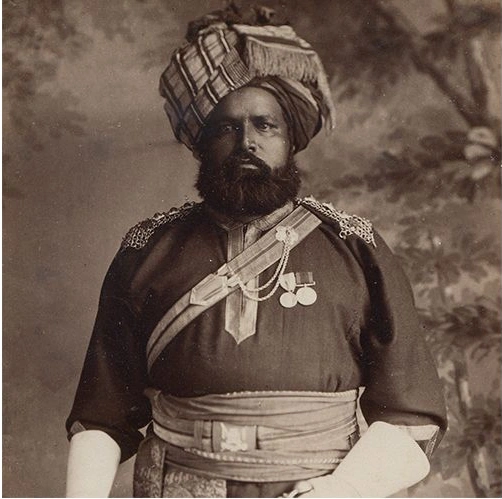
Fighting some of the most notoriously gruesome and merciless forces of the time, he carefully managed his soldiers’ behaviour to ensure minimal injury, death and cruelty. Having fought in the Second Anglo Afghan War (1878-80), he was renowned as a brilliant and successful military figure, praised in newspapers across India and back in England. He fought against 700 Waziri warriors with only 37 soldiers, and managed to disperse them and prevent them from attacking a British convoy. Stories of the British Indian Muslim cavalry officer being full of adventure, danger and bravery captivated the imagination of the British press and public
Nadir was such a valuable part of the force that he was even photographed by Queen Victoria's own photographers, an unusual occurrence in all but the most impressive of Indian soldiers’ records. He was one of only 13 Indian officers to serve as Royal Escort to Her Majesty The Queen Empress (Queen Victoria) in the Royal Jubilee of 1887
Sadly, he never received the Order of Merit recommended to him for his service, one of the highest military awards of the time. He died of pneumonia while still in service on the 13th of April, 1890. Through this initiative, his descendents hope that his memory and skill will be remembered
Gul Mawaz Khan
Risaldar Major Gul Mawaz Khan, Babar Raja's great grandfather, was born in the little village of Siloi, Northern India (now Pakistan), on the 25th of April, 1873. Born to a famous military hero, Major Nadir Ali Khan, and his wife, Gul Mawaz Khan grew up with the values of loyalty and courage instilled in him from a young age
An accomplished horseman, he quickly rose through the ranks of the cavalry and became noted for his calm and clear head in a conflict, and for his bravery. He was made a Risaldar (a cavalry officer) in the King George the V's Own Lancers. He was later appointed to appear on King George V's staff in 1911, and, for his services in World War I, recommended for the Order of British India, second class and then, in 1919 first class.
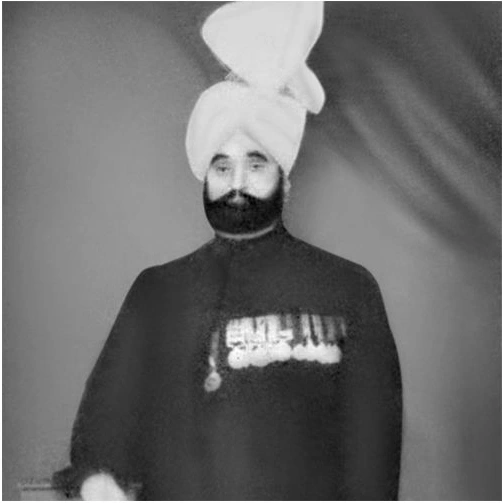
His greatest achievement would come in the face of one of the worst conflicts ever seen by man: World War I. Fighting for Britain against the Ottoman Empire in the Middle East, he became involved in one of the most complex intelligence operations of the war.
The main person to correspond personally with King Hussein of Mecca on behalf of British was Gul Mawaz Khan, after which the Arab Revolt shaped into success for the British; the Ottoman Empire, fighting in allegiance with Kaiser Wilhelm's Germany, posed a serious threat to the British during World War I
The success of the intelligence mission - in which he developed networks of support for the British in the Arab Revolt and gained intelligence of enemy activity - was appreciated by King George V, who recognised that Gul Mawaz Khan's contribution was a game changer for the British in the war, as well as the world. This was a man who left behind everything he knew in Northern India for the unfamiliar landscape of the Middle East, all in the name of loyalty. He was later made an Honorary Captain in the British Indian Army in 1920.
But his efforts were never fully recognised, despite being recommended for the Military Cross, a highly prestigious military award; an award he never received. This oversight was so great that his superiors in the Indian Office even wrote of the incident to Foreign Secretary Austen, Chamberlain, in 1924, stating to him that Gul Mawaz Khan had been “badly mistreated... he has sacrificed a great deal and has received no compensation. In these serious times in India those who are loyal and true deserve the full thanks and recognition of the government.”
Upon his retirement in 1924, he was granted the extraordinary sum of £453 and 12 shillings
for his service: a modern equivalent of a six-figure annual income, as well as a jagir (feudal parcel) of land, living peacefully until his death in 1945